Half The Work Is Done For You: Picture Poems
©S. Ingraham and lightshedder.com
This is a very straight forward, simple exercise that students have a lot of fun with. Though I have always thought I developed it myself, I have seen it, or something very like it, in several different books about teaching poetry, and I have seen it used by several other teachers (if in slightly different contexts). I guess it’s just on of those exercises that is so obvious that it gets invented over and over, wherever people are trying to teach others to write. Picture Poems are easier for most people than Is Poems, and some of the students who struggled hardest with the Is will come right out and ask why we didn’t start with Picture Poems. Every time I do this with students I debate the sequence, but, so far, I have always decided that part of the reason they find Picture Poems easier is because the hard work of beginning to think in similes, metaphors, and images has already been done. Even those who don’t feel like their Is Poem worked got, evidently, enough out of the exercise so that when we get to Picture Poems, they move easily into as/like thinking and image. Also, the Is Poems, conceptually, are more closely linked to what we learned in Lets Get Physical and Inside Out and Outside In theory. They build more directly on the foundation of using real objects and actions to build meaning, of using a crisp exterior to express something interior. So, so far, the Picture Poems always come after Is Poems, the next step, the next layer in the building.
I introduce the exercise this way:
“Someone once said (I wish it had been me) that the poet is a painter with words, and that the painter is a poet with a brush. It’s true, isn’t it? We have just been talking about the fact that poetry is made out of real objects and actions. The poet selects and arranges pieces of what’s out there into a pattern, an image, that has meaning, in both the poet’s mind and in the minds of the reader/listeners. And what does a painter do? (We are talking about traditional painting here, representational painting, painting of recognizable chunks of the world—we can talk about abstract painting later if you want.)” Get them talking here. Try to draw the conclusion out of them. “The painter does the same thing as the poet, only, instead of words on paper (or in the air) the painter uses pigment on canvas to capture or create an image that has meaning.”
“What the photographer does is even more like what the poet does. How many of you take pictures?” Hands. “So what do you take pictures of?” I play off the responses here to lead them to the conclusion that we take pictures of things that have meaning to us, situations and scenes we want to remember because they are important to who we are, or are becoming. You might have to ask them to actually take a mental rummage through the last roll of film they shot or through the family photo album.
“What about professional photographers? How do they make pictures? What do they take photos of?” Again, there will be some discussion here. You may have to lead the students through their memories of photos they have seen in ads, in magazines, in books. What I want them to realize is that the professional photographer creates or captures images that have meaning, not only for the photographer, but for almost anyone who happens to see the picture.
“And how,” I ask, “is that different than what a poet does?” I ride right over anyone who might be thinking that it is different. I know there are lots of differences, but that is not what I want them thinking about right now. I want them to focus on the similarities. “It’s not. The photographer goes through the world looking for images that have meaning and records them on film. Click. The poet, at least in part, goes through the world looking for images and situations that have meaning, and records them in words. How different is that? Not much.”
“So,” I say, “one of the easiest ways to write a poem is to start with a photograph. Half the work has already been done for you. The photographer has already found a scene or situation that has meaning and frozen it on film so that you can take a good long look at it. What more could you ask? All you have to do is turn the image into words.”
“You remember I said poems could be written from the inside out or the outside in? Which was the Is poem? Were the Is poems written from the inside out or the outside in?” Some will remember the discussion, but many will have to figure it out all over again, especially if it has been a week or more since we did Is poems. “Did the Is poems start with something on the inside and move out to real objects and actions to find expression, or did they start with the outside and discover some inner meaning?” So you get them to agree that Is poems are inside out poems. “And, if you start with a photograph, as I am asking you to, what kind of a poem will you get: inside out or outside in?” Discussion as needed. “So here we are going to write our first outside in poems. I suspect that at least half, more likely two thirds of all poetry written is outside in. The poet sees or hears something first, and it wakes resonances, sympathetic vibrations inside. The poet suspects there is meaning contained in the experence and discovers it by writing it out.”
I have a big pile of photographs (and some reproductions of paintings) that I have collected over the years. Some are from calendars that I buy when they are two years past the date for 50¢ each at the Bargain Barn; some are printed out from CDs of clipart and stock photos; some are from the Internet. I put the whole pile on a table in the middle of the room.
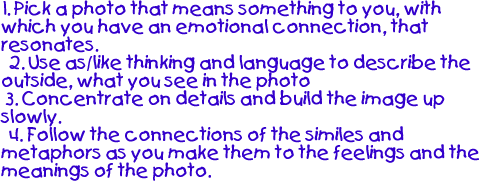
“So, here are some photos. What I want you to do is to pick one and use it as the seed of a poem, that will be the outside for you poem. You want to pick a photo that you have some emotional connection with, one that you like (or dislike), one that makes you feel happy, or sad, or mad, or just all and warm and fuzzy on the inside (these are calendar pictures, there will be lots of those). That’s half the trick. Pick a photo that means something to you.”
I generally draw back a do a little exploration of the concept
of resonance and sympathetic vibration here, taking them through what they know
about musical instruments (many will know enough to pick up on the metaphor)
or, if all else fails, working through the old shattering-the-glass-with-her-voice
trick. (Most of them will have been in at least one car with such a kicking
stereo system that you can feel the bass through the floorboards and stuff on
the dash won’t stay put when the volume is cranked.) “So, I tell them,
there are emotional resonances as well—sympathetic vibrations of our souls
that we pick up from the world around us. When we feel it we know, though we
may not know exactly what we know. you want to pick a photo that generates its
own inside, that resonates with your mind and heart, that moves you, that awakes
the sympathetic vibrations of your soul. You don’t have to be able to say
exactly what the inside is yet. We will get to that in writing the poem. It
should be easy. The photographer has already done most of the work for you.
The photographer has already found an image that resonates. That’s why
the picture got taken in the first place.”
“Once you have your picture, don’t go for feeling or the meaning right away. Just begin by describing what you see in the photo. Where is this? What is this? Who are these people and what are they doing? What is that green thing in the corner there? What do those clouds look like? Focus on details. Describe the outside—the things you actually see in the photo. Describe details to build up the image of the photo in the reader/listener’s mind. As you describe, use as/like thinking. It is not a “blue sky,” it is a sky as blue as...” It is not a “forest,” it is “a forest like a church with the light slanting down through stained glass windows.” or “a forest covering the hills like a patchwork quilt all in red and orange.” Get the idea? Ask yourself, “What does that fence remind me of? What do those ducks look like? What does that tree make me think of?” Use simile and metaphor to describe what you see in the photo. Once you mind begins to think in connections, you will move naturally to the feeling the photo gives you, to what it means to you. The feeling and meaning will get into the “as”s and the “like”s you choose, without your ever having to come right out and say it. The feelings and meanings will just be there, in your description, and therefore in the mind of the reader/listener when you share your poem.”
Again I write the steps on the board:
I tell them, “Don’t worry about making it look or sound like a poem
yet. Just describe the picture. Make it a paragraph if you need to. We’ll
dig the poem out later.”
Again, this is something you will what to do yourself, as the students are doing it, in the intervals between helping others. I tape my photo up to the board and write my poem up there beside it, revising as I go along.
What I am doing with the students as the write is to circulate and to keep pushing them back to the details of the photo, encouraging them to use simile and metaphor. “What is that thing there? What does it look like to you? It’s as green as...” “Don’t go to the feeling yet. Give us the picture. We have to have the picture to hand our feelings on. We have to see the picture you are seeing to figure out what it means. Don’t tell us, show us.” “What do you see there? What are those people doing? Who are they? What does that man look like to you?”
Push them back, way back (like the cheerleader’s say at the football game), push them back to the outside of the photo, to what is actually there. Get them thinking as and like. It’s easier than I am making it sound. Block every field goal attempt: don’t let them go for the end zone of the feeling/meaning until they have fought their way up the whole length of the photo field. End run similes are allowed (encouraged), and a forward pass metaphor can cover a lot of ground, but they have to give us the game before we can appreciate the final score. (Sorry, I got carried away there, but you get the point.)
As with the Is Poems, at the end of the first block of writing time, I have them circle up and ask a few brave souls to read the start of their poems, or even a particularly good line. I have been looking over their sholders as they wrote, and offering encouragement and advice, so, generally, I know who has a good start. If they don’t volunteer, I might just ask one to read. “Hay I know Josh as got something good going there. Why don’t you share it.”
Finally, I assign them to have a completed draft of a picture poem by the next class.
And here is another way of saying it. True story. Only the names have been changed to protect the guilty.
Picture Poems: for Chris
(or outside in poetry)We are attempting picture poems.
I point out that the photographer has already done half the work
selecting, out of all the world, just this one scene,
this scene that speaks, that carries meaning, that resonates,
and recording it, with all the art available in the photographic process,
on film, rendering a slice of the world and time as this particular print.I encourage them to begin by just saying what they see,
using “like” and “as” to describe, reaching for the apt metaphor,
for the startling or illuminating connection.I push them back again and again to the photo,
to what’s there, to the outside, trying to make them work thorough
the words of their description to the meaning it has for them,
to let the image speak, find its voice inside them,
waking their own voices
as they discover what they want to say in saying it.“Just tell me what you see.
Tell me in simile and metaphor and image.
Stretch for connection.
See where the connections take you.”They are always tempted (as are we all)
to go right for the the feelings,
for the emotions the photo evokes,
(the easy stuff)
to write down ten lines of abstract nouns and passive verbs
and call it a poem.“No,” I say,
“when I read it I have to see the picture.
You have to begin by letting me see what you are seeing,
you have to give me something real to hang my understanding on
or it is just words.”“Begin with what’s really there and develop description,
line by line, simile, metaphor extending into image,
so the last lines burst, inevitably, with the “moral of the story”
like a flare shot from a gun,
and turn the description
inside out
illuminating
a sudden landscape of the soul.It’s not the only way to write a poem,
but it is a way.And it gets at one root of poetry,
where real objects speak,
and in speaking, say both who we are,
and, if we listen closely enough,
maybe, even, what is true for us all.