© S. Ingraham, lightshedder.com
from Inside Out and Outside In
For the first lesson in what poetry is all about, I like to ask the group to bring in 4 objects each. Each person brings two objects which have some kind of personal meaning. Generally these would be objects that have strong memories attached to them. They might bring the box a first corsage came in, a teddy bear, a signed baseball, a favorite tool, a ship or airplane model, a hair brush, a pet’s toy, a curry comb, something from their own room, etc. I discourage photographs at this stage (somebody will ask1 ). The other two objects should be picked up at random on the way out the door.
(To be safe, I always put together a big box of random stuff from my house, in case too many of them forget to bring something. If this is going to work you need a big, diverse, pile of stuff.)
On the day, we pile all our stuff in the middle of the floor
(or put it all on a couple of tables pushed together if that works). People
may be reluctant to put their “treasures” in the pile. I just tell
them we need a big pile and everyone will be very careful with their stuff (won’t
we!).
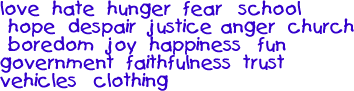
Next we generate a list of idea words: abstract nouns, names of emotions and
concepts. It might look like this:
We write the idea words out on slips of paper and put them in a hat. Then we
divide up into random groups of three or four. Each group has to pick a word
from the hat and then select a up to 5 objects from the pile (or 6, or 7, depending
on how big your pile is) which can be arranged to represent or to express that
emotion or concept. We make a contest of it. “Look,” I say, “don’t
let any other group know what word you got. You are going to build your arrangements
one at a time and it is the job of the other groups to guess what you are trying
to express. It’s a little like charades only you are working with objects
and you can’t act anything out. It’s a contest!” I give them
about 5 minutes to discuss among themselves, then let them all grab from the
pile. Then they get about 5 minutes to figure out how to arrange the objects
they selected. I walk around and observe what they are doing. I also select
a group of objects from the left-overs and build a physical poem of my own.
Occasionally, I see that they are just not getting it. I then get their attention
and have them try to guess my poem. If they do appear to be getting it, I will
hold my own poem in case there are no volunteers to go first when it comes time
to guess. In an ideal situation I hold my poem until after everyone else has
done theirs.
Students present their physical poems one group at a time. The rest of the students have to try to figure out what the group was trying to express, and give their reasoning. The presenters then give their reasoning. That’s round one.
I generally try to spice things up with a little humor, coming up with some really outrageous interpretations of their efforts, and some equally outrageous reasoning. It just makes it more fun, and loosens up the group.
Generally, on the first round almost all the groups will use what I call the “symbolic” method, that is, they will choose a group of objects each of which has some association with the concept and put them down on the table in a somewhat random arrangement. (Photo) (Photo) There is another way to solve the problem, what I call the “dramatic” method. You can create a little snapshot of a story or a scenario that will make the viewers think of it for themselves (a tableau). If all the presentations were “symbolic” I have the students try to see the similarity in their presentations and analyze the method (I help them with this if necessary). I then introduce the idea of the “dramatic” method. If we had a mix, then I try to get them to analyze the differences and describe the two methods.
This leads to round two. In round two every group has to use
the “dramatic” method (still without moving anything). (Photo)
(Photo)
Round three, I let them move their objects and I also tell them that they can use one word, by writing it in big letters on a piece of paper, to stand in for an object they can’t find in the pile (or to represent an action they can’t mimic). Obviously they can’t write their word on the paper! (Photo) (Photo) (Photo)
This activity is a lot of fun. Every group I have tried it with, from children to adults, has really gotten into it, and it is one they remember long after they may have forgotten most of what I said in the course. Adults or motivated writers may skip right over the “symbolic” representation. That’s okay. Go with what happens.
The object of all this, and the conclusion, is to get across the idea that:
Poetry is made out of real objects and events—stuff we can see, hear, touch, taste, smell, and experience. The poet arranges the objects and events of the real world in a way that makes meaning for both the writer and the reader. Of course, the poet uses words to stand for the objects and to describe the events—but it is the objects and events themselves that build most of the meaning.
I tell them that if they don’t learn anything about writing
from me but this, then I will consider myself a success. I tell them that I
want this engraved on their brain stems by the end of our study. I write it
on the board and make them copy it into their notebooks.

This is a foundational exercise, a way of establishing a shared memory that we will refer to again and again over the course of our study of poetry (and writing in general). We want to establish a shared vocabulary based on common experience so that when I say, “but okay, where are the objects and actions in you poem,” I can be confident that they will know what I am talking about. Besides, it’s a lot of fun and establishes, from day one, that poetry should be, must be, playful.
That’s a lot of work to get out of one exercise.