Poetry Is For People
© S. Ingraham and lightshedder.com
I often begin our year long exploration of poetry by asking
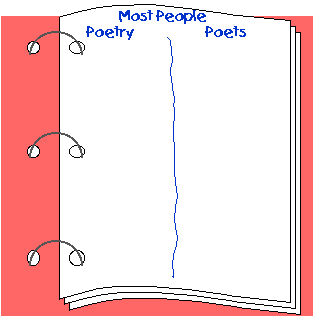
my students to draw a line down a piece of notebook paper to divide it
into two columns. They label the two columns: “Poetry” and “Poets,” and
the whole page “Most People.” Like this:
“Now,” I say, “take five minutes and make a list of all
the words that you think “most people” would use to describe poetry and
poets. Any word. Every word. As fast as you can.” I time them, and warn
them when they have only a minute, and then only 30 seconds, left.
Then I ask them to draw a line under their lists and to lable the bottom
of the page “Me.” Like this:
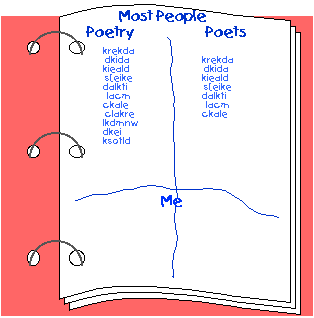
“Okay,” I say,” now add any words to either column that you, personally, would use, but that you don’t think most people would.” I give them about two more minutes here. I draw the same grid on the board. We then do a whip around the room to collect words (“Give me the best word on your list under Poetry... Next person... Next... Next...”). We keep going around until we aren’t getting any more new words, and then I ask, specifically, if anyone has any words to add to the list. A second whip collects their personal words.
Sometimes, depending on the group and how well I know them, I do this as a group inquiry, drawing the columns on the board and just asking students to call out words to fit the sections, “Okay, in 2 minutues, give me all the words you think most people think of, when they think of poetry and poets.” We sort out the “most people” and “me” words and lable them with squares and circles (or some other symbols) as a first step in processing the lists.
As you can imagine, in most groups of teen and older students,what we get is mixture of positive and negative attitudes toward poetry with the negative generally outweighing the positive. To demonstrate this, I will have the group sort the list by positive and negatives and neutrals, using plus, minus, and equal symbols (+, -, =). Then too, many of the positive attributes of poetry and poets in the minds of “most people” are, as far as I am concerned, veiled negatives, in the sense that they, while they sound nice, they are either not true, or they are recognizable distortions which perpetuate a particular mythous associated with poetry—a mythous which, as you will see, I am out to destroy.
In most groups I might say something like what follows, and I would be able to point to individual words on their own list to make most of the points:
“In our culture today, too many people think poetry is something for a special set of people—people who are somehow extra sensitive, extra talented, or, just a little strange. Poetry is difficult. Poetry is hard to read. Poetry is hard to write.”
“Poetry isn’t serious. Poetry isn’t practical. All that flowers and feelings stuff is okay if you like it, but I have more important things to do. Poetry is a waste of time, not worth the effort to read or write. Poetry is a luxury.”
“To be a poet you have to be either a slightly unattractive female with an overactive imagination and odd taste in clothes—or an introverted male with glasses, long hair, and a prominent adam’s apple (which, as you get older, you will probably grow a beard to hide).”
“Normal people don’t do poetry.”
Those who like poetry, but don’t fit their own preconceptions of what “poetry likers” are like, are just slightly ashamed to admit it. Those who write poetry too often do so secretly, never showing it to anyone but a particular friend or two, filling journals or maybe just the occasional scrap of notebook paper that gravitates to the bottom of the closet or gets tucked into the back of the drawer. Can you hear someone in our culture saying, in a crowd, “I like poetry!” and not sounding just slightly defensive or defiant? Wouldn’t be more like “...but, I like poetry...” Can you hear someone saying, right out loud, in front of strangers and friends alike, “Oh yes. I am a poet.” That takes a bit of courage today.
Part of it is, of course, that we are so unsure if what we like and what we write is real poetry. We have a vague standard in our minds that says, whatever real poetry is, what we do isn’t. Where do we get such ideas?
It is especially difficult, in our culture, to be a male poet. Girls can like poetry. Girls can write poetry. Boy’s, real boys, can’t and, if they know what is good for them, don’t. And yet, in my experience, there are just as many teenage boys among the secret poet set as there are girls.
Of course, I am convinced everyone starts out liking poetry. Children just learning to read and write don’t have these prejudices. Children respond the the run and rhythm of the words, the playfulness of the language, the pictures a poem makes in your mind and they don’t even know it is poetry. Children dance to poems. Children speak in poems. But somewhere along the line, between learning to read and becoming a teen, “most people” become afraid of poetry. By the time we are adults, the fear is so deep seated that poets and poetry are effectively ghettoized. Poetry still exists in America, but it is kept within a very small, almost closed, community, with its own magazines, its own reunions and conventions, its own language. Its kind of like Star Trek fans without the funny suits and wrist communicators.
Then I ask them why. “Where do you think these attitudes toward poetry come from?” We take some time (when we have it) to talk about their feelings and experiences.
If I am speaking to a group of teachers about all this I might point out that teachers are adults (even most English teachers are, at least nominally, adults) and that, perhaps, scary as it may sound, it just might be from us that most kids learn to fear poetry. Is it our own fear of poetry that is infecting new generations? I am always amazed at how many teachers—English teachers, Language Arts teachers—are reluctant to teach poetry because they just don’t feel they understand it.
And, to be honest, poets and poetry lovers have to take part of the blame. Poets tend to develop what I call a “defensive arrogance” about what they do. It’s like “well, if you were smart enough, you’d get my poem!” It’s like, “well, of course you don’t understand it. You are too normal!” It is very like math arrogance. You all know how math people, people who think in math, just exude an attitude of “if you were only as smart as I am you would understand math too.” Well poets do the same thing, only they don’t get the $60,000 jobs right out of college, so they have to be more subtle about it.
Then too, just as with math, it is difficult for those who get poetry to understand why others find it so difficult. “What’s not to see? What’s not to like? Isn’t it obvious that the poem about the potato is really about growing old gracefully? Isn’t this fun!”
So, what is the flip side. What is poetry and being a poet if it is not what “most people” think.
I once taught this Inside Out and Outside In workshop to my own and another home schooling family on Saturday mornings. The father in the other family was highly resistant to the whole idea of poetry. He had all the prejudices. And yet, when talking about anything that mattered to him, he naturally spoke in poems. He was constantly using metaphor, building off metaphor to make an extended image. He was a preacher and he had clearly learned to listen to his own voice. He let the sound of the words and the shape of his breath guide him from image to image. He just didn’t believe that what he did was poetry.
A few months later my wife was explaining my workshop to the program director of our local arts organization and she said, “What he teaches is that everyone does poetry. We speak in poetry all the time. We just don’t write it down.”
Poetry is a way of making sense out of the world. Poetry is a tool for finding out what you think and feel. Poetry is a way of expressing the deepest and most intimate truths we have available a human beings. Poetry is a way of taking our personal experience of the meaning of our lives and making it available to others.
Poets know just a few tricks about thought and language that “most people” don’t.
Poets think in similes, metaphors, and images—building meaning out of the objects and actions and events of the real world, but arranging them into patterns, into pictures, that make the connections between them clear, and reveal the inner sense of things.
Poets have learned to love and trust the language. They know that there is a wisdom in the sound of words and the rhythm of speech, encoded there by a thousand thousand generations of thinkers and speakers, and they have trained themselves to follow the patterns that have been built into our tongues to unexpected, often unsuspected, meaning.
Poets enjoy playing words. They understand that in playing with words they are playing with reality, and they let their play lead them to truth, but they don’t let the truth spoil their fun.
Poetry is easy if you think like a poet. Easy to write. Easy to read. It’s fun. It’s essential if you want to express anything beyond the facts of your situation. Not just in poetry either. Thinking like a poet, exploring the inner connections between things, is essential if you want to understand the world around you. It is essential in any kind of good writing, from the novel to the memo. If you don't read poetry, then you will miss some of the best “stuff” people have thought and felt about life.
Poetry is for people. Poetry is for everyone.