
Poetry Is... / Is Poems
Learning to expand “as/like” thinking into images
Part Two: The Is Poem
After spending time with the three poems about poetry, I point out that they
are all written to a pattern. “Poetry” is “some physical object.”
I write that in in big letters on the board.
Then I ask them which is the inside and which is the outside. This may take
some discussion to establish. Despite using them to look at the poems about
poetry, the terms are still new to them. In the process of discussion I ask
them to take another look at the list of descriptors for the Inside and the
Outside on the Inside Out and Outside In Theory handout. I hit on the
abstract / concrete line and use the rest of the descriptors to build a sense
of what abstract and concrete mean. The concrete side, especially, needs emphasis.
Concrete means some “thing,” some object, some specific object, that
you can see, touch, taste, hear, or smell. A sense object. A particular sense
object; the more particular the better.
So now we have on the board:

“Okay,” I say, “this is a particular kind of poem. I call it
the Is poem.” I tell them that Is Poems are classic “inside
out” poems. The poet begins with a thought, feeling, or insight—with
an abstract notion—and gives it expression by linking it to some concrete,
sense object. The Poet then expands on that link to build an image, and, thereby,
builds a poem. We then turn back to the board and I underline the “Poetry
is object” line and ask them what this is, what name we give this type
of description by comparison? Many will recognize it as metaphor. A few will
be able to remember the name. Much of the time I have to write in the word “like”
after the “is” and take them through simile, erasing the “like”
to take them to “metaphor,” but we get there. Now comes the mini lecture
on metaphorical thinking and expression.
They have already heard what I have to say about metaphorical thinking several times before. It gets into my general introduction on “why we study English.” It is certainly part of the A Picture Is (Not!) Worth 1000 Words piece. It is, of course, the reality that underlies the Lets Get Physical activity. It is something I say over and over, in different ways, and in different contexts, all year long, hoping that eventually it will make sense to them.
What follows is a “high level” exposition of the theory of metaphorical and imagistic thinking and expression. It is clearly not something I would say to kids. For my students it gets translated down into a kind of socratic discussion, with lots of questions, lots of examples, as I try to build this meaning with them, using bits of what they already know.
In order to express an abstract concept or a complex emotion
a poet begins with a simile or metaphor. We begin with “as/like” thinking.
Love is “like” a silver dollar (to pick an object at random). Love
is like a chinese slipper.
Then the poet looks at the object in his or her mind, turns it in imagination
to look at all sides, takes it apart to see what is made of or how it is put
together. The question is “how is love like a chinese slipper?” The
answer is “love is like a chinese slipper because...” As each detail
surfaces the poet thinks “now, how is that like love? What part of love
is like that? What can I use that aspect of a chinese slipper to say about love?”
I call this “zooming in” on the object. Of course, to able to do this,
the object has to be really concrete. It has to be very specific. You have to
have a particular chinese slipper in mind, and you have to be able to see it
clearly in your mind, to remember how it feels in your hand, to smell the foot
powder (or foot odor, as the case may be), to see the frayed edges of the seams
where the buckle strap is pulling loose. Zoom in! As connections come between
love and the parts of a chinese slipper, you write them down.
Next the poet “zooms out.” You look at the slipper in it’s context. Where is this slipper? In a bedroom? Under the bed? Kicked way back under the bed with the dust balls? Is it on a shelf, kept like a memory? Is it on a foot? Who’s foot? Is this a slipper that has been handed down from a previous generation? Is it an imitation of such slippers? Is it still in the store? Is it still in the box it came in, wrapped in crinkly off-white tissue? Who made it? Is it the product of child labor and some American corporation's sweat shop? Is it just one more item in a flood of cheap imports? What is it made of? Where did the cotton cloth come from? How about the rubber sole? (And asking that takes you back to the zoomed in level because you suddenly see how thin the sole is, how little protection it provides from the rough walks of life, etc.) Is this slipper on the foot of a child dancing in the snow?
Again, as connections are made back to the concept of love, you write them down. Of course, for the practiced poet, the flow of this is much more natural, much less arbitrary. The poet zooms in and zooms out simultaneously, seeking connections faster than the eye can follow. The poet follows any and every connection to see where it goes, if it, by any chance, will lead back to the concept from a unexpected angle. It is amazing how often it does.
Students, however, can benefit from doing this exercise very
deliberately, sequentially if necessary. Create a simile or metaphor. Link a
concept and an object with the word “is.” Zoom in on the object. Zoom
out. Record all connections. Follow all connections. See where it takes you.
I tell them this is so easy you can do it with any concept and any object. I
tell them you can pick them at random and make it work. Then I prove it to them.
“Okay, give me, fast you can,” I say, “a list of abstract nouns: names of emotions, relationships, collective objects, institutions, etc., just like we did in the Lets Get Physical exercise.” I list them on the board under abstract.
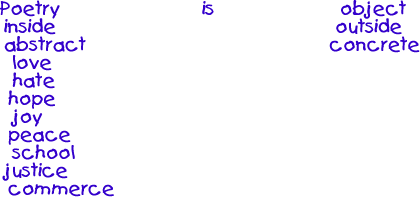
“Now,” I say, “give me a list of concrete nouns: names of objects you can see, hear, taste, touch, or smell. Be as specific as possible. Not “tree” but “birch.” Come on, fast as you can. Objects. Any objects. Look around. Name some objects.” We get something like:
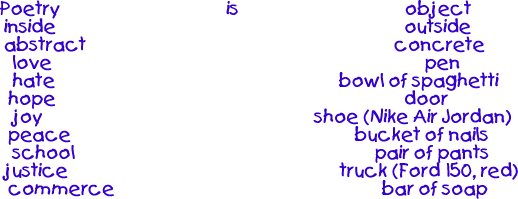
You have to push a little on items like “shoe” or “truck”
to get them to visualize a particular shoe or truck—otherwise they are
really collective nouns and not specific enough to be of much use.
“Now,” I say (I seem to say “now” a lot), “we can match any abstract with any object and make an Is poem out of it. Go ahead. Pick the two most unlikely. Pick the hardest pair.”
The first time I ever did this they picked “love is a bowl of spaghetti.” So, okay, we zoom in. Picture the bowl. What kind of bowl is it? Plastic? China? Pottery? Big? Small? What color? Nice white bowl so the sauce shows up? Dark blue?” I get them to answer these questions and pick the one that works best. “What does the spaghetti look like? Is it all coiled neatly in the bowl? Did they mix the sauce in first, or is it poured in a puddle in the middle with white spaghetti showing all around? Is there parmesan on it? What does it smell like? Oregano? Is the sauce thin or thick and oily? Does it have green peppers in it? Mushrooms? Is it homemade or Ragu from a jar? Is it warm? Did they heat the bowl first before putting the spaghetti in? Is it left-over spaghetti, fresh from the refrigerator, kind of slimy and all stuck together?
Then we zoom out. “Where is the bowl of spaghetti? Is it in a restaurant? One of those little Italian places with checked table cloths? Is it in your grandmother’s kitchen? Is it sitting on a table in the church basement at a pot-luck? Where does spaghetti come from? What is it made out of? What kind of wheat? Did you ever think about what kind of machine makes those long thin noodles? Do you know the story about where tomatoes came from? What about the whole Italian thing? Pizza, spaghetti, garlic bread, grandmothers?”
Then I open the poem, playing around: “Love is a bowl of spaghetti because...” Generally someone will come up with something. If not, I might prompt them. “Love is a bowl of spaghetti because you have nourishing pasta and a spicy sauce, so mixed up you have to eat with both a fork and spoon.”
Love is a bowl of spaghetti because... “its
messy.” This from the class.
“Some people cut it up small, some people spin it in a spoon, some people
slurp it in one noodle at a time, but almost everyone gets sauce on themselves
before they’re done.” This from me.
And we go on. Spinning out the connections, seeing where they take us. I remind them they have probably seen this following the connections thing done before. Most of them have been introduced to the concept of webbing or concept mapping as a pre-writing technique, and what we are doing here is not so different. Sometimes they do all the work and I only have to laugh and affirm them in their creativity. Sometimes I have to do most of the work, but even then I see the smiles flicker and the lights come on in their eyes and know they are liking it—they are getting it—seeing the possibilities, understanding how it might work. Then too, they are getting the idea that poetry is play—that this zoom in, zoom out thing is a habit of the mind that is fun.
What we are doing here, I remind them, is expanding a metaphor into an image. We are taking a basic similarity between a concept and an object and turning it into a whole complex of connections, spinning it out into an image that the reader/listener can enter, a tableau like the ones we created in Lets Get Physical, a little drama that will give the reader/listeners the experience of the concept—that will let them feel what you mean, that will build a set of connections in their minds that will lead them to your insight about that concept. As a bonus, you are getting to explore just exactly how you do feel—you are getting to discover the insight that will validate the poem. This process works because it follows the way the mind stores information, the way we make sense out things in our own minds. Our understanding of the universe is stored as a pattern of connections in our minds. When you touch any detail of an object you can follow the connections out like a web, through your mind and your memory, and in doing so, discover unexpected relationships, unexpected meanings, unexpected truths.
Generally I share the story about the first time I tried this exercise and these two little poems:
Love is the bowl of spaghetti my grandmother used to make,
sitting on the checked tablecloth in the old kitchen
in the white porcelain bowl of her family pride,
the nourishing noodles, the hot pasta,
lapped in olive oil of her hope, wound tight as the strings of her heart,
entwined as the threads of our lives, slippery and hard to hold
as our separate wills, drenched in the sauce of her devotion,
the deep simmered essence of tomato, the forbidden fruit of desire
cooked past any danger, and served up spiced with
the oregano of her wisdom, the sweet basel of her patience,
and pepper (her secret ingredient), that hint of cayenne in her eye.“You want more?” She would say.
“You want more! Look at you. Eat up. It’s good for you.”And it was.
Or equally...
Love is a bowl of spaghetti in the little Italian restaurant
where I took her, the checked table cloth, the waiters
with warm smiles and knowing looks, their little English
making a magic circle of privacy, of comfortable intimacy around us,
where she taught me, after much trying, to eat noodles
with both fork and spoon, spinning together, getting more
than either utensil could ever on its own, where we did the sucking in
one long pasta string until we kissed thing, where we, inevitably
got sauce on my shirt, on her blouse, stained ourselves
with matching stains so deep no bleach will ever take them out!
(I don’t have an Italian grandmother, and I have never done the sucking pasta thing, but that doesn’t mean I don’t know what they mean.)
Of course, I tell them, it is easier to write an Is Poem if the concept and the concrete already have something in common—if the object is one that you naturally think of when you think of concept. It’s easier, but it might not be as much fun. Sometimes taking really unlikely combinations leads to the deepest insights. The real trick is to pick a concept that you are invested in—an emotion you are feeling strongly just now, one of those collective nouns that really has your attention at the moment (like “school” maybe, or “freedom).
“Now it’s your turn.” I say. “Write your own Is poem. Just take a concept, an abstract, and connect it with “is” to a concrete object. Make it something you can really see, hear, touch, taste, smell—something specific not general. Make the concept something you care about, something you want to work out right now, something you have something to say about. Turn your object every which way. Zoom in. Take it apart to see what it’s make of. Connect back to the concept from as many details and parts as you can. Write it down. Zoom out. Put the object in a setting. Make it a prop in a little drama. Make connections back to the concept. Follow the connections to see where they take you. Somewhere in this process you will begin to find a poem. Grab on and ride it down, write it down, and you will have an Is Poem. It’s not the only way to write a poem, but it is one way, and it gets at the heart of what good poetry is really about.” And then I quote them back the words from the end of the Lets Get Physical exercise:
All good poetry is made out of real objects and events—stuff we can see, hear, touch, taste, smell, and experience. The poet arranges the objects and events of the real world in a way that makes meaning for both the writer and the reader. Of course, the poet uses words to stand for the objects and to describe the events—but it is the objects and events themselves that build most of the meaning.
While they are writing, or attempting to write their poems, I will be doing one on the board—writing as I always write, a few lines at a time, revising as I go, spinning it out in front of them. I don’t actually know if anyone ever watches what I am doing, but I figure it can’t hurt to see me doing it with them.
Between lines I will bop around the room looking to see what they have going, encouraging those who are stuck, affirming those who moving. If you can get them to do this sequentially, one step at time, then anyone can do it. I write the steps on the board in big letters.
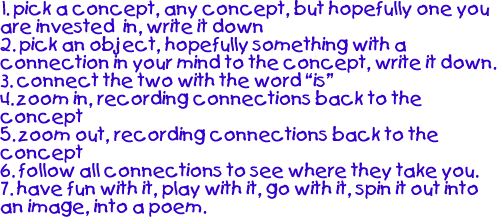
I have a set of probing questions I find myself asking over and over again to get them going at each step, to guide them through the first steps so they can see the possibilities.
“Pick a concept. So what’s bothering you right now? Any particular conflicts? Getting along with your girl/boy friend, your parents, your brother/sisters? How are you feeling these days? What’s rubbing you the wrong way. What’s chaffing at you? What do you want to get off your chest? Is anything especially wonderful happening to you right now? Are you in love? Do you have new car? Are you on a winning team? What’s happening at work, at your job? What do you feel today?”
I push. I insist they write down a concept before I will go away. Even the most reluctant will generally come up with something and get it down on paper rather than have me hanging over their shoulders for more than 5 minutes. Once they write down a concept I give them the next instruction: “Write “is” next to your concept word. Now think of an object that goes with concept, or just put down the first thing that pops into your mind.” Then I go away and bother someone else for a while.
So, after maybe another 5 minutes I get back to them. Some will not have written down an object. Some will not have written “is.”
“So, okay, write down “is” there next to your concept word. That’s good! One step at a time. Now an object. What do you think of when you think of “love?” (or “hate” or “jealousy” or whatever the concept is). Push. Encourage. Don’t take no for an answer. “Pick an object—something you can touch, taste, smell, see, hear.” The most common problem at this step is that they want to link two concepts. “Love is a fire.” Well, okay. You can do something with that, but “fire” is really a concept as much as “love” is. “What kind of fire? The flame on a gas range or camp stove? The fire at the surface of the sun? A wood fire in a fireplace? The bonfire on homecoming day?” If you can push them to the specific, the really concrete, then they have something to work with. “Okay, it’s the bonfire at homecoming? Zoom in. What does it look like? What is it built out of? Can you smell it? Can you feel the energy? How is that like love? Love is the bonfire at homecoming because...? What do the planks and pallets represent? What do the sparks flying up represent; what part of love?” Get them seeing the object in their minds. Get them seeing the possibilities. Encourage them to write something, anything, down. “Just write down a list of the connections as you find them. Don’t worry about making it sound good at this point. Just write it down.” Give them space to write. Get back to them to take them through the zoom out phase. Most will have caught on by this point.
One of the barriers is that students do want to make it sound like (and look like) a poem right away. Some will instinctively be able to do that, just by keeping the lines short. For most of them I tell them, “Just put it down as a paragraph for now. We’ll learn to dig the poem out of it later. I can show you how to do that too.”
You do get a few “if it doesn’t rhyme it can’t be a poem” folks. So, it they want it to rhyme I tell them, “You can do that. It makes it harder, and it isn’t necessary in this kind of a poem, but, if you want to try it, go ahead. It might be better just to learn this trick of expanding a metaphor into an image and save the rhyme for later, but, hay, do what you have to do. Just don’t let the rhyme stop you from doing anything!” This issue is addressed a bit in Poetry Is Play.
You will also get a few students who, for one reason or another, will give you a “why do we have to do it this way” attitude. They may, legitimately, be accomplished poets who find the exercise artificial and arbitrary. I tell them to try it anyway. It will be good for them. “Struggle is good for you.” Who knows, they might still learn something valuable. You can never be reminded enough times that poetry is built out of real objects and actions.
Some of the “why do we have to do it this way” attitude will come from those who think they write poetry, when, in fact, they write good verse. I differentiate “verse” and “poetry.” Verse, I tell them, is a form in which the major attractions are ideas and form (generally rhyme). Verse is pretty. Verse is clever. Verse sounds good. Verse is about feelings and emotions and relationships. But that is just it: verse may say something about feelings, but no attempt, really, is made to generate those feelings in the reader/listener. Verse may say something about relationships (or about truth or justice or love for that matter) but no attempt is made to take the reader/listener into the experience of the poet. Verse, generally, has no real objects and actions in it, only words about things, no real things. “Verse is not bad. Verse is a valid art form in and of itself. There is some very good verse out there. However, we are learning to write poetry, and I’d like you to try this.”
Finally, some of the “why do we have to do it this way” attitude will come from those who are just using it as an excuse not to try. Their real issue is something quite different. They are afraid of failure. They are unsure of the value of their thoughts and feelings. They don’t believe they have anything worthwhile to say. Encourage, encourage, encourage. Don’t take no for an answer. “You can do this! One step at a time.”
Or maybe it is that, like many of us, they just don’t want to have to think. This feels too much like work. They want the poetry to just flow out of them like water from a tap. They want to be carried away on a tide of inspiration. And if they aren’t, they won’t believe it’s poetry. They don’t want to have to work at it. “Hay, I tell them, if you want water from the tap, first you have to turn it on. First someone had to do the plumbing. First someone had to drill the well. Poetry is work. As my Grandfather used to say, “If it was easy, everyone would do it.” If you want to be swept away by the tide of inspiration, first you have to get yourself to the beach. First you have to get down to the water’s edge. First you have to get up the courage to get your feet wet. Don’t tell me about tides while you are still miles inland from the shore. Get up and go look for the water. That’s what this exercise is all about. Come on, just put one foot in front of the other. Just walk to the ocean, dip your toe in. Be brave!”
I shamelessly bully the reluctant writers in the group into at least giving this a try. I know it works. I know anyone can do this. I know each of them can do this. I know it will be good for them when they do. I don’t let them alone until they have tried.
And I am always surprised when it works!
As encouragement, when we have finished the lesson, I have them circle up and try to get at least a few of those who I know have made some real progress to share the beginning of their poem. It’s okay if it is not finished. It’s okay if its not polished. I just ask them to share what they have so far. Then I assign them to finish the poem for the next time we meet (or to produce one if they haven’t gotten a start yet).
The Is Poem. Metaphor expanded into image. It’s a lesson every poet needs to learn.
Once, while doing this with a group of more motivated writers at a Maine Writing Project Young Author’s Camp, one of the students said, “Oh, I get it now. It’s like you take these two things that don’t seem to have any connection, and you just kind of hold them together in your mind and see what happens. And stuff happens! You begin to see the connections and were they go, and you find all kinds of surprises, and that’s a poem!”
“You got it,” I said.
Metaphor
Casey is playing coy over his Mary Poppins metaphor
on the day we begin to fumble toward images,
to play with the subtle and mutlifacited connections
between concept and concrete,
to joke our ways to our first class poems,
so I try, in the spirt of the thing, to get up a basketball cheer,
clapping, “K C, K C, K C” in a stadium voice at front of the room,
and Bethany looses it, hooting like a loon,
holding her sides, weaving dangerously in her chair,
and the rest of them go off in a gale,
slapping tables and snorting laughter through their noses,
and we are children together there for a long moment,
and me just the biggest of them.Except for Steve.
Steve hangs, head down, between two tables on his knees,
bracing himself, holding tight to his negativity,
trying to suck all the energy
out of my show, out of our show, with his.“This is why I hate English.” he groans,
“It turns you into...one of these!
I’m going to have to dust him, if this doesn’t stop.”And he gets meaner,
mocking John’s voice when he starts to read his metaphor,
and I am tempted to walk over and kick him while he’s down,
only the laughter, the poetry, the metaphors,
are still high enough in me so
I just shake my head instead.John handles it well, better than I,
pausing, “Whenever you’re finished Steve,” he says,
and then reads a poem complete,
concept and concrete,
a metaphor woven into image and used
to cast a clever flash of insight into our eyes,
and blind our ears and dazzel our nerve ends,
and I clap, we clap, this time to say “John scores.”“I think you’re beginning to rub off on him,” says Steve,
connecting John and I with what he thinks is surly glance.
I don’t think, dispite the hint of envy in it, he means as it as a compliment
to either of us.I can see John thinking, furiously, where he sloches behind his table,
“I’ve always been this way. This is me. Not that you’d notice.”And, to save the moment,
I tell them all we used to click our fingers instead of clapping;
they remember some teacher telling them about poetry cafes
in the fifties, and go out snapping.One of these days, I’m going to have to have a heart to heart with Steve,
to find out just exactly what it is about metaphors that scares him so.
Poetry is play.
(not an “is” poem)
Greg wants to make his “is” poem rhyme.
“Poverty is...”
he has on his paper,
so I say, “Make it rap...
take it and rhyme it to a beat,
find the rhythum and the rhyme
and run with it, boy.”But he doesn’t. It’s forth block on a Friday,
last class of the week,
(after a Thursday off too)
and nobody wants to school.(Ha! How little they know,
how little I’ve taught them,
if they still think poetry is school!)So I come up with a line or two.
“Poverty don’t a agree with me,
leaves me always hungry...”*
But Greg is still having none,
can’t find the fun,
so I’m off on the board,
tongue like a sword,
word after word,
runing the rhyme,
taking my time,
tuning the lines,
chasing down inspiration
playing the fool in the poetry nation.And I perform it for them,
rapping it out,
Pov er ty don’t agree wi’me,
leaves me owlways hung gr y...”
putting my body in it
(who says old white men can’t dance),
taking it into their faces, doing the paces,
rubbing it in a little for the laughs.
And they are shocked.
A little sheepish to see the teacher
carrying on, so obviously “losing it,”
right there in front of them.
“Where are you getting this...” Greg askes,
grinning despite himself,
and Anna-Lena, our German exchange student,
lights up, a pinochio person suddenly alive,
hands turned up and out on the strings of her excitement,
and wants to know,
“Ver ist all dis commink frum?”I just tap my head and put on a knowing look,
a jester mocking his own wisdom,
(if I had bells on my cap they would ring as I tap, tap, tap)
and then I dance on back to the board to lay down another line
to say some more, to play some more, while I’ve got the time.They don’t get it yet,
but all poetry is play.Poetry is fun.
If I could give them just that one
and teach them to run
then my job would be done.
*
poverty is a hole in the head
let it get’ch, you better off dead
poverty don’t agree with me
leaves me always hungry
value meal? what a steal!
ol’ MacD’s deceitful mouthful,
cheap toy, toss it, boy,
get the real deal.feel the sun,
find the real fun,
cause I’m the one,
I’m here for you,
change in my pocket,
grab on to the rocket,
hope in my heart,
lets get a start,
get up and work, jerk,
cause poverty
don’t agree
with no bud y.(hit the back button to go back to the text)