It is, first, and above anything else, an attempt on the part of the poet to use language to make meaning, to discover meaning in the world around us, to make sense out of life. It is a marriage because the poet has discovered that there is a wisdom in the words themselves, a wisdom in the patterns of sound and the rhythms of speech, a wisdom built into our language, that, if followed, often leads to important insights about life, often leads to unexpected meaning, often leads to ways of making sense out of experience that could not have been reached otherwise. Poetry is communication. The poet has something to say, a meaning to convey, a bit of sense to share, but the poem is intended to do more than just say it. A poem is intended to lead the reader through the language to discover truth, to make the meaning, to experience insight, to share the feelings and emotions. The poem is intended, ultimately, to give readers the words and images to make sense out of their own experience, and to do it in a way that delights the eye and ear, that takes the breath away, that is memorable, elegant, and efficient.
|
|
|
| what the poet saw/heard/did
(what the poet imagined) |
what the poet felt/what the
poet thought
(what the reader is intended to feel or think) |
| concrete/objective | abstract/subjective |
| sense data/observation | feelings/emotions |
| surface/situation/picture | purpose/intent/insight |
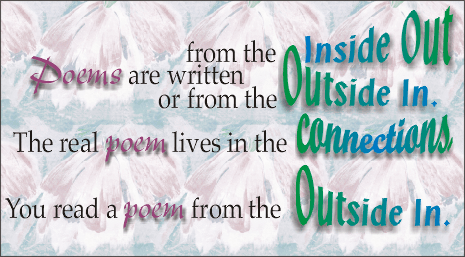
The poet is always thinking “that’s like...” “that’s as blue as...” or “that’s as sad as...,” making connections between the outside and the inside and following those connections to insight and truth. The poet is always looking for resonances, the subtle sympathetic vibrations between objects, events, thoughts, and feelings that lead to unsuspected connections, unsuspected patterns, unsuspected meanings.
When we read a poem, it is essential to get the Outside
before you look for the Inside. If you don’t see what the poet saw, hear
what the poet heard, smell what the poet smelled (or in the case of an
Inside Out poem, what the poet wants you to see, hear, or smell in imagination)—if
the actions and events of the poem are not clear, then you can not feel
what the poet felt, or think what the poet thought. The image of the poem
will not help you to make sense out of your experience until you actually
get it, receive it, recreate it in your own imagination.
Poems are made of real objects,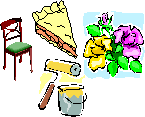
actions,
and events (the outside),
represented by words,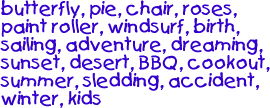
and arranged in a way that makes meaning (the inside) for the poet,
and for/with the reader.
Trying (once more) to Name PoetryAll poetry begins with an intense encounter with the world, with reality,
an entanglement with something we can see, touch, taste, smell, or hear,
with some event that we react to, with something that we do, that moves us.(For instance, this resort to formalistic utterance, to pontification, is
the result of sixteen frustrating encounters, over the past three days,
with students who think, by the evidence of their work,
that you can build a poem out of nothing more than
words about ideas and feelings.)But it also has, right down near the root, as a first action, an equally intense
encounter with language.(It is, you see, the word “encounter” itself, leading by way of the ear to
“entanglement” in the next line and “event” in the one after,
that finally frees the energy of my frustration,
that causes the impulse to utter to coalesce into this concrete expression,
that makes me willing to make one more attempt to get this truth down
and into their reluctant heads.)(And perhaps now you can see, as I do, this instant,
in response to what I’ve written so far,
that imagination is in there too. That the words are not enough without
some agent to order them, some inner builder of context
to bring out the meaning by making the relationships,
the patterns, explicit.)Poetry arises then in a four way collision (collusion even)
between reality, imagination, language and the poet.Reality provides the matter and the substance of the poem,
the originals of all imagined objects and actions,
the very impulse to utter.
Imagination is the inner arms and hands that arrange the
the stored memories of things and deeds, that sets them down
next to each other in unexpected patterns to see what will happen,
how they connect, where the edges dissolve and reform.
Language has rules of its own, a built in wisdom at the roots of words,
in the patterns of syntax, in the sounds of speech, that, working with
imagination, take the action often into unexplored territory.
The poet controls it all, and is controlled, provides the will
to understand, the will to move, is pulled this way and that
by the others, until, crying “enough already,”
the poet brings the poem to tongue and lips
(too often by way of fingers)
and says whatever is discovered,
what needs, in the end, to be said.You can picture it as a wrestling match,
three against one,
or a tug-of war with the poet in the middle,
or as a dance,
you can image it as competition, cooperation, or collaboration,
but the end is same, a move in some definite direction,
with the 4 contestants, the 4 participants, so equally balanced
that there is no winner, only the movement, and often a subtle movement at that.
You might even call it a game (as I see, without knowing it, I have).
You might even call it play.In the end it comes to a single act,
poetry, the poet speaks.And, of course,
in the process the reality, the encounter, that started it all
is transformed, opened, revealed, illuminated,
named, tamed, set free, stirred, turned,
understood, explored, exploded, concentrated,
compacted, spit out, chewed up,
digested, swallowed whole, and served up.Because poetry itself is also an action:
what the poet does to reality
as well as in response to it.There is power in poetry,
power over reality in speech,
and the poet knows it.
That’s why the game is worth playing.Nothing is real until it is named.
Nothing is fully real until you have put it where it fits.The poet is the one who gives us all the words and images
for what we feel and know.
That is real power.Which is why, I suppose,
I seem to spend a so much time
doing this...
trying, over and over, to name Poetry.